|
Getting your Trinity Audio player ready…
|
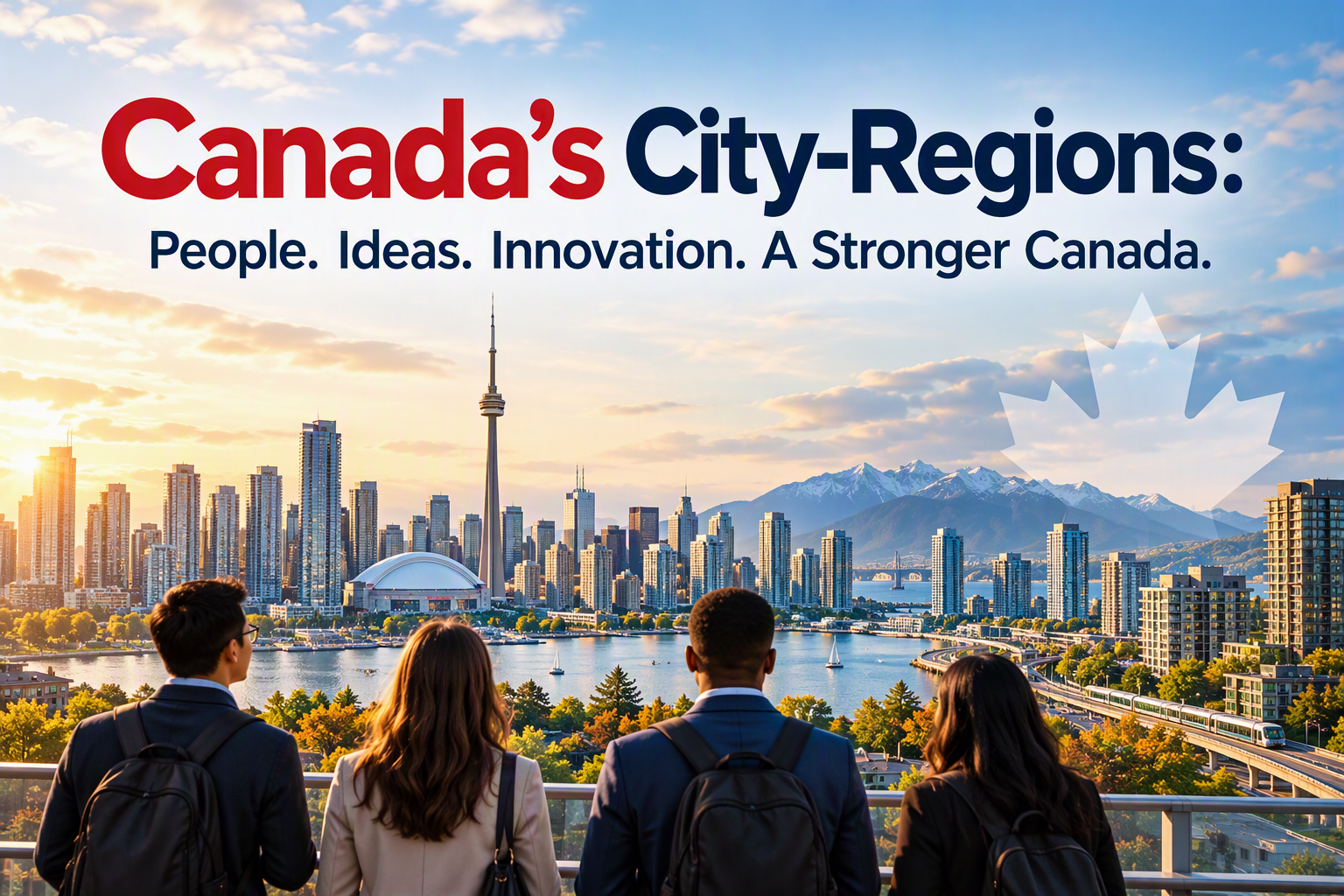
In an age of heightened trade wars, geopolitical uncertainty, and rapidly shifting global markets, Canada cannot take its economic prosperity for granted. As countries compete aggressively for investment, talent, and innovation, Canada’s greatest competitive advantage may not lie solely in its natural resources or national policies. Increasingly, it will rest on the strength of its city-regions. The metropolitan regions surrounding cities such as Toronto, Vancouver, Montreal, Calgary, Edmonton, and Ottawa-Gatineau are emerging as powerful innovation ecosystems that will play a defining role in Canada’s future prosperity.
Canada’s Urban Century
Over the past century, Canada has undergone a remarkable urban transformation. What was once a country of relatively small and fragmented municipalities has evolved into a nation organized around large metropolitan regions. Today, most Canadians live, work, study, and innovate within interconnected urban systems. As a result, Canada’s economic success is becoming increasingly tied to the performance of its major metropolitan areas.
Consider the Greater Toronto Area. What began as a collection of distinct municipalities has evolved into one of North America’s largest urban economies. Similar patterns appear in Metro Vancouver, the Montreal metropolitan region, and the rapidly growing urban corridors around Calgary and Edmonton. While municipal boundaries remain important for governance, these regions function as integrated economic spaces where people, businesses, capital, and ideas move across local borders every day.
Why City-Regions Matter
The economic power of city-regions stems from what economists call agglomeration effects. When businesses, universities, research institutions, skilled workers, entrepreneurs, and consumers cluster together, opportunities multiply. Ideas spread more quickly. Firms gain access to specialized talent. Partnerships emerge more easily. Innovation accelerates. Quite simply, proximity fuels productivity. Far from being administrative conveniences, city-regions drive growth in the knowledge economy. They create the conditions that allow innovation to flourish and businesses to scale.
Canada’s Metropolitan Success Stories
Canada’s leading metropolitan regions demonstrate this dynamic. The Toronto region has become a globally significant centre for finance, technology, and advanced services. The Waterloo Region has earned international recognition as an innovation hub, showing how strong university-industry connections can drive entrepreneurship and technological breakthroughs.
Montreal has established itself as a leader in artificial intelligence and aerospace, while Vancouver has built competitive strengths in clean technology, digital media, international trade, and logistics. Calgary and Edmonton are increasingly positioning themselves at the forefront of energy innovation and emerging technologies.
Together, these city-regions show how local assets can become globally competitive economic ecosystems.
Laboratories for Innovation and Problem-Solving
These metropolitan regions do more than generate economic growth. They are also serving as laboratories for policy innovation. Challenges related to housing affordability, transportation, climate adaptation, infrastructure, and economic development often emerge first in large urban areas.
Metropolitan collaboration lets governments and community partners develop coordinated solutions that no single municipality could implement effectively on its own. In many respects, Canada’s city-regions are becoming testing grounds for the policies that will shape the country’s future.
Competing on the Global Stage
Most importantly, city-regions are Canada’s gateways to the global economy. Toronto competes for talent and investment with cities such as New York, Chicago, and Boston. Vancouver increasingly competes with Seattle and San Francisco. Montreal’s reputation in artificial intelligence attracts international attention, while western Canadian metropolitan regions continue to attract investment in energy and technology sectors.
In today’s economy, cities are not merely local governments. They are global competitors. Their ability to attract talent, capital, and innovative firms increasingly shapes national economic performance.
A National Imperative
The message is clear: Canada’s future prosperity will be built in its city-regions. In a world where investment, talent, and innovation are increasingly mobile, countries that empower their metropolitan economies will thrive. Canada’s city-regions already possess extraordinary assets, including world-class universities, diverse populations, entrepreneurial talent, and globally connected industries. The challenge now is to unlock their full potential.
That means investing boldly in transportation networks, housing supply, digital infrastructure, research capacity, and innovation ecosystems. It means strengthening regional collaboration and providing metropolitan regions with the tools they need to compete on the world stage. Most importantly, it means recognizing a simple reality: when Canada’s city-regions succeed, Canada succeeds.
The twenty-first century will be won by places that can attract talent, generate ideas, and transform innovation into economic growth. Canada’s city-regions have all the ingredients to lead. The question is not whether they matter. The question is whether the country is prepared to invest in them with the ambition and urgency an increasingly competitive world economy demands. If Canada wants to remain prosperous, innovative, and globally competitive, it must make empowering its city-regions a national priority.